No ISO or BSCI certification is universally mandatory by law for jewelry packaging. Requirements become binding in two situations. A buyer contract may demand a specific certificate. Alternatively, a supplier may need documented proof of compliance with regulations in the destination market.
Companies selling into Europe, North America, or to large retailers often treat BSCI and ISO as mandatory. That pressure comes from buyers, not from statutes. This post separates legal requirements from buyer requirements. It also clarifies the difference between ISO standards and the BSCI audit framework.
Puntos clave
No law says jewelry packaging must have an ISO or BSCI certificate everywhere.
Buyer contracts and the rules of the market where the goods are sold often require these certificates.
ISO 9001 and ISO 14001 are standards for running a management system, while BSCI is an audit program.
Pick the certificate that fits the exact order and market. This helps you avoid paying for things you don’t need.
Ask your supplier which certificates they already have. This saves you time and money.
Legal vs. buyer requirements
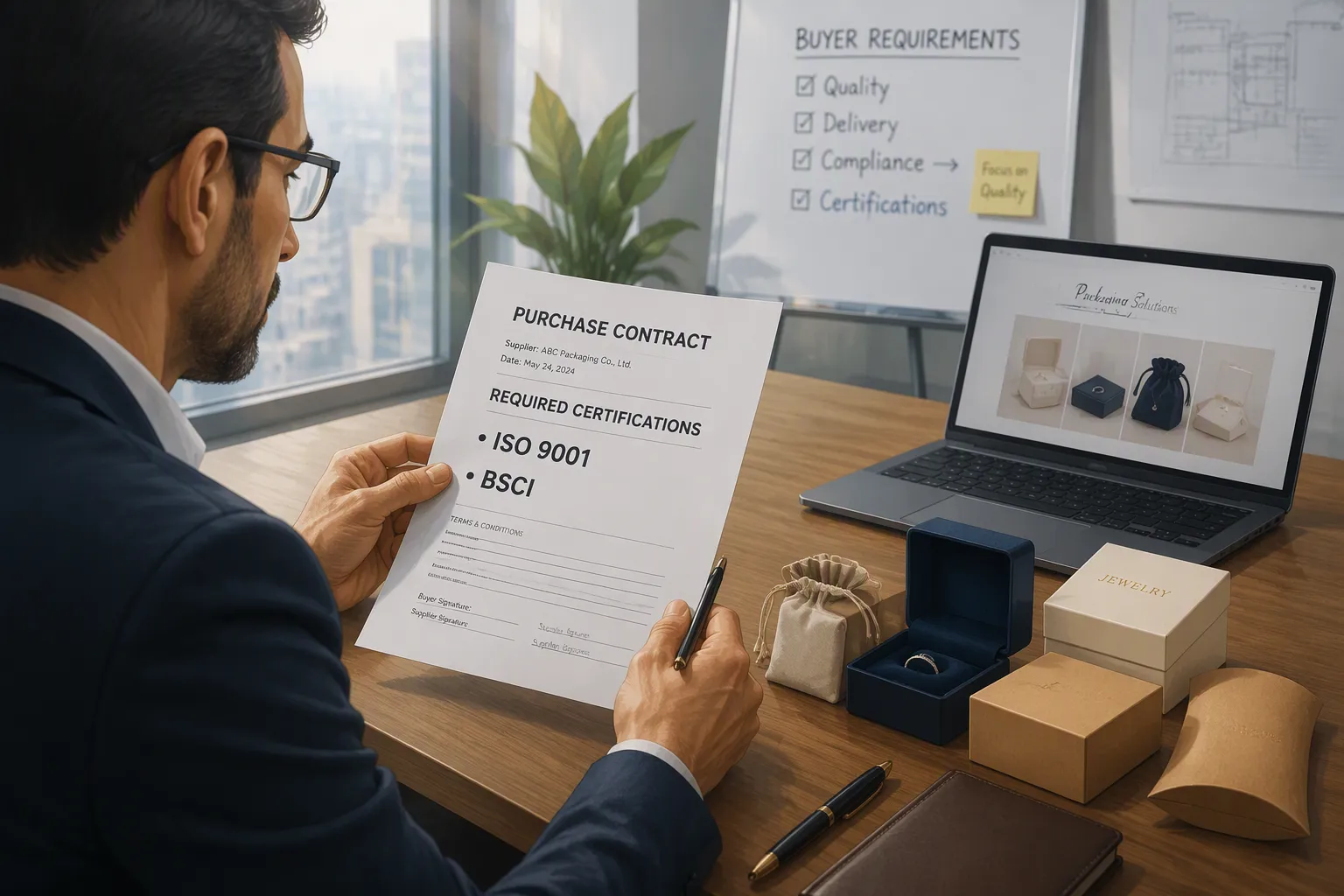
No single ISO or BSCI certificate is required by law everywhere for jewelry packaging. Requirements change based on three things: the buyer, the target market, and the retailer. A supplier sending plain paper boxes to a local wholesaler may not need any certification at all. That same supplier sending to a European department store chain may need several. Knowing this difference helps you avoid wasting money on certificates that no one will ever ask to see.
What the law requires
Laws rarely name a specific certificate. Instead, they set the results that must be met. A destination market may limit certain substances, require recyclable materials, or demand labels in a local language. The law says what the product must do. It does not say which certificate proves it.
Two things can turn a voluntary certificate into a real need. The first is a buyer contract. A purchase agreement may list ISO 9001 or an amfori BSCI audit as a condition of the order. Once signed, that clause has the same force as any other contract term. The second is proof of regulatory compliance. A customs authority or market surveillance body may accept a recognized certificate as evidence that goods meet local rules. In that case, the certificate works as documentation, not as a legal requirement by itself.
Suppliers should read both carefully. A contract clause creates a private duty. A regulation creates a public one. The two often overlap, but they are not the same.
When buyers make it mandatory
Large retailers and brands selling into Europe and North America often require ISO 9001, ISO 14001, or a BSCI audit from their packaging vendors. This demand comes from buyers, not from laws. The retailer writes the rule into its supplier code and its purchase order. A factory that cannot produce the document loses the order, even though no law stops it from operating.
This pattern explains why many suppliers call these certificates mandatory. In practice, they are mandatory for a specific customer, not for the whole industry. A jewelry packaging supplier serving boutique brands may never need a BSCI audit. The same supplier pitching a multinational retail group will need one before the first sample ships.
The practical lesson is simple. Ask the buyer for the exact certificate name and the exact version. Ask which market the goods will enter. Then check whether a regulation really requires documentation, or whether the buyer simply prefers a familiar logo. Tongxing Packaging Co., Ltd. holds recognized certifications and can confirm which documents apply to a given order, which helps buyers avoid paying for audits that add no value to their specific shipment.
Buyers comparing suppliers can also review joyeros personalizados, expositores de joyas, and pouches to see how certification claims map to actual product lines. A certificate covers a management system or an audit scope. It does not automatically cover every item a factory produces.
ISO standards for jewelry packaging
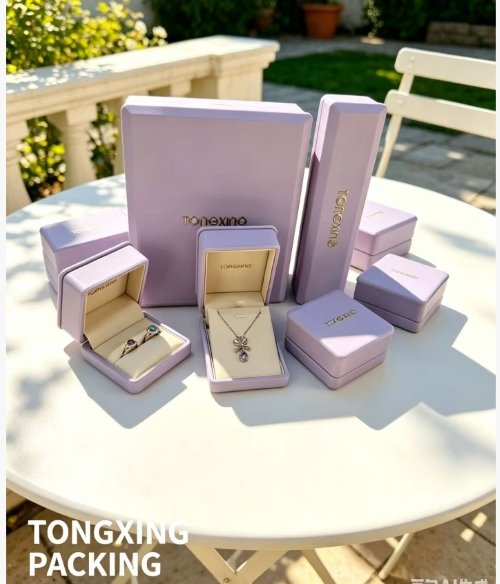
ISO certificates are management-system standards. They describe how a company runs its processes, not what a single box looks like. An accredited certification body audits the factory against the standard and issues the document. ISO 9001:2015, for example, can be issued by certification bodies such as DCI Certification. The certificate proves that a quality system exists and that an auditor verified it.
ISO 9001 and ISO 14001
ISO 9001 covers quality management. A certified factory writes down its procedures, tracks defects, and fixes problems the same way each time. ISO 14001 covers environmental management. It shows that a company measures and controls its impact on the environment.
Neither standard becomes mandatory through legislation alone. Two triggers make them binding for a given order. The first is a buyer requirement. A retail group may write ISO 9001 into its supplier agreement and refuse samples from uncertified vendors. The second is an export regulation. Some destination markets accept a recognized certificate as evidence that goods meet local rules. In that case, the certificate serves as compliance documentation at the border.
A supplier of jewelry packaging should confirm which trigger applies before paying for an audit. A boutique customer may never ask for ISO 14001. A European retail chain may ask for both standards in the same purchase order.
Other standards buyers request
Buyers also request standards that target specific materials or claims. Four appear often in jewelry packaging supply chains:
FSC covers paper and board from responsibly managed forests.
REACH addresses chemical substances placed on the European market.
GRS applies to recycled textile content, which matters for fabric pouches.
GOTS covers organic textile production, also relevant to pouches and bags.
Each standard addresses a different aspect of the product. FSC says nothing about chemical safety. REACH says nothing about fiber content. A logo on a box therefore does not equal complete quality assurance. Buyers should read the scope of each certificate and match it to the material in question.
Tongxing Packaging Co., Ltd. is one example of a supplier that holds recognized certifications. Founded in 2003 and headquartered in Shenzhen, the company offers one-stop service from design to delivery. Buyers can review its embalaje de joyas range and custom paper boxes to see how certificate scope maps to actual product lines. A certificate covers a management system or a defined audit scope. It does not automatically cover every item a factory produces, so matching the document to the order remains the buyer’s job.
BSCI in jewelry packaging supply chains
An audit framework, not a certification
amfori BSCI is a program that checks and improves factory conditions. It is not a certification. A factory does not “get BSCI certified” the way it earns an ISO 9001 certificate. Instead, an independent third party inspects the site using the amfori BSCI code of conduct and writes a report.
The idea is like ISO 9001 and ISO 14001. All three depend on outside checks and a written record of what was found. BSCI is different in one key way. It does not force a fixed management-system setup. A supplier does not need to build a written process map before the audit. The auditor visits the site, notes problems, and the supplier answers with a plan to fix them. For serious findings, a follow-up audit happens within 12 months of the date the problem was found. Suppliers audited through the amfori BSCI system then get a status from A to E.
That status letter matters to buyers. It gives them one shared scale for comparing factories across countries. It does not replace a quality certificate, and it does not show how a box is built.
When buyers require a BSCI audit
A BSCI audit becomes mandatory only when a buyer asks for it. No law names amfori BSCI as a condition for selling jewelry packaging. The requirement comes through a supplier code, a purchase order, or a retailer onboarding checklist.
The demand usually follows the customer, not the product. A brand selling through a large European retail group may face a BSCI clause in its vendor agreement. That brand then passes the clause down to its packaging supplier. A supplier serving small independent jewelers may never get such a request.
Packaging suppliers often hold amfori BSCI alongside ISO 9001 and ISO 14001. The combination covers three different questions: quality systems, environmental systems, and audit status. Tongxing Packaging Co., Ltd. keeps recognized certifications across its jewelry boxes and display lines, and buyers can confirm the current scope before an order. Checking existing documents first often removes the need for a new audit.
Comparing ISO and BSCI requirements
Which applies under which conditions
The table below shows when each document becomes binding. It covers four angles: technical performance, application fit, regulatory compliance, and cost.
Document | Becomes mandatory when | Technical performance | Application fit | Regulatory role | Cost profile |
|---|---|---|---|---|---|
ISO 9001 | A buyer contract names it, or a market accepts it as proof of compliance | Covers quality management processes | Fits any packaging line | Supporting evidence at the border | Recurring audit and surveillance fees |
ISO 14001 | A buyer contract names it, or an export rule requires environmental paperwork | Covers environmental management processes | Fits factories with measurable environmental controls | Supporting evidence for environmental rules | Recurring audit and surveillance fees |
amfori BSCI audit | A buyer’s supplier code or purchase order demands it | Reports site findings, not product quality | Fits suppliers serving large retail groups | Not a regulatory document | Audit fee plus follow-up costs |
FSC, REACH, GRS, GOTS | A buyer claims the material attribute, or a market rule applies | Targets one material or chemical aspect | Fits paper, textile, or chemical-specific lines | REACH carries direct legal weight in Europe | Varies by scope and material |
Each option fits a different job. ISO 9001 suits buyers who want proof of a stable quality system. ISO 14001 suits buyers tracking environmental management. A BSCI audit suits retail groups that compare factories on one shared scale. Material standards suit specific claims, such as recycled content in a pouch. Tongxing Packaging Co., Ltd. may supply every option, so buyers can match the document to the order rather than the other way around.
Matching requirements to cost
Every audit carries a price. A supplier pays for the first review, the surveillance visits, and any follow-up. Those costs eventually reach the buyer through the unit price. A buyer who demands three certificates for a small run of bolsitas para joyas pays for paperwork that the order may never need.
The practical rule is to match the requirement to the actual shipment. Check the buyer contract first. Then check the destination market rules. Then ask the supplier which documents already exist. Tongxing holds recognized certifications across its jewelry boxes y expositores de joyas, and confirming current scope often removes the need for a new audit. That step protects the budget and keeps the timeline short.
No certificate is required by law everywhere for jewelry packaging. What applies to a certain order depends on buyer contracts and the rules of the market where the goods are sold. A supplier may need nothing for one customer and several documents for the next.
Readers should check three things before they assume a certificate is required. First, read the buyer contract to find the exact standard names and versions. Second, confirm the regulations of the target market. Third, ask the supplier which documents already exist.
Tongxing Packaging Co., Ltd. holds recognized certifications and can confirm what they currently cover. This helps buyers avoid paying for audits their order never needs. Reviewing custom jewelry boxes alongside those documents shows how each certificate maps to the actual product.
PREGUNTAS FRECUENTES
Is BSCI a certification?
No. amfori BSCI is an audit program, not a certificate. An independent auditor visits the site and writes a report with a status grade. Buyers use that report to compare factories. A supplier cannot “hold BSCI certification” the way it holds an ISO 9001 certificate.
Does the law require ISO 9001 for jewelry packaging?
No law names ISO 9001 as a condition for selling jewelry packaging. The standard becomes binding only through a buyer contract or as supporting evidence for a market rule. Buyers should read the purchase agreement before assuming the document is required.
Does one certificate cover every product a factory makes?
No. A certificate covers a management system or a defined audit scope. It does not automatically cover every item a factory produces. Buyers should confirm the scope against the specific order, such as custom paper boxes o bolsitas para joyas, before relying on it.
What should a buyer ask a supplier about certifications?
Buyers should ask three things: the exact standard name and version, the scope the document covers, and the market rules that apply to the shipment. Tongxing Packaging Co., Ltd. holds recognized certifications and can confirm current scope for its expositores de joyas and box lines.
Can a supplier skip an audit if the buyer does not ask?
Yes. A supplier serving local or boutique customers may need no ISO or BSCI document at all. The requirement follows the buyer and the destination market. Confirming existing documents with a supplier such as Tongxing often removes the need for a new audit.