Sixty-five percent of modern jewelry buyers now demand transparency in sourcing, and that number keeps climbing. A single ring can pass through dozens of hands across continents—from the mine to the cutter, the setter, the jewelry packaging manufacturer, and finally into a custom jewelry boxes or Jewelry Pouch. Opacity at any stage hides ethical and environmental risks. Transparency is the bridge between values and what a buyer actually wears. When sourcing is transparent, buyers gain the power to say yes to responsible practices and no to exploitation, greenwashing, and conflict. This is not a niche concern. It is a mainstream expectation shaping how couples shop, how brands compete for loyalty, and even how a Jewelry Display tells its story.
What Transparency in Jewelry Sourcing Really Means

Defining Traceability From Mine to Market
The Journey of a Gemstone
A gemstone travels through five main stages before it reaches a buyer. These stages include mining, refining and smelting, cutting and polishing, trading and brokerage, and setting and finishing. Ethical risk sits mainly in the first three stages. Transparency in jewelry sourcing means a buyer can see clear visibility into this journey, from raw materials to the finished product. It answers key questions. Where was the diamond mined or grown? Who crafted the piece, and under what conditions? What environmental and ethical standards were followed? This traceability from mine to market enables consumers to verify ethical claims and align purchases with personal values.
Why “Known Origin” Isn’t Always Enough
A known origin tells a buyer where a stone came from. It does not explain how workers were treated or what environmental damage occurred. Single-country origin is becoming the new standard for transparency, yet origin alone leaves gaps. A diamond may come from a conflict-free country while still involving forced labor or unsafe mining conditions. Full traceability requires data at every stage, not just a label on a certificate.
Certifications and Standards Explained
Kimberley Process and Conflict-Free Diamonds
The Kimberley Process Certification Scheme tracks rough diamonds from mine to export. It verifies that shipments are not from conflict zones. However, this certification does not cover labor, environment, or cutting conditions. Buyers who want certified ethical sourcing need more than a Kimberley Process certificate.
Responsible Jewellery Council and Fairmined
The Responsible Jewellery Council certifies adherence to ethical, social, and environmental standards. Fairmined certification goes further by requiring annual audits from independent firms. Fairmined mines also receive regular visits from a technical team. These programs support traceability through certifications that buyers can verify.
Recycled and Lab-Grown Material Claims
Recycled metals and lab-grown diamonds offer alternatives to mined materials. Brands must document ethical standards for these sources too. A lab-grown diamond claim means little without proof of origin and production methods.
The Difference Between Transparency and Marketing
Spotting Vague Sustainability Language
Many brands use terms like “eco-friendly” or “ethically sourced” without evidence. These words have no legal definition. Fairmined notes that such terms often come from companies that fail to provide proof. Buyers should treat vague language as a warning sign.
What Real Disclosure Looks Like
Genuine transparency requires documentation. A transparent brand publishes supply chain reports, names artisans by region, and invites third-party audits. Verifiable traceability means a buyer can request certificates of authenticity, refinery certifications, and audit reports. Real disclosure values full traceability over marketing claims. Buyers who ask for proof separate honest brands from those that rely on appealing words.
Why Modern Buyers Demand Supply Chain Transparency
Modern jewelry buyers no longer accept vague promises. They want proof. They want data. They want to know the full journey of every stone and every gram of metal. This demand for supply chain transparency has grown from a niche preference into a mainstream requirement. Buyers now treat ethical sourcing, lab-grown alternatives, and documented supply chain practices as baseline expectations rather than premium extras.
Ethical Concerns Drive Purchasing Decisions
Ethical concerns now sit at the center of jewelry purchase decisions. Buyers ask hard questions about where materials come from and who handles them. They want assurance that their money does not fund harm.
Avoiding Conflict Diamonds and Forced Labor
Conflict diamonds and forced labor represent two of the darkest problems in the jewelry supply chain. Many diamonds link to brutal mining conditions, child labor, bonded labor, and violence. Human rights organizations describe these practices as modern slavery. Amnesty International and Human Rights Watch report that Kimberley Process certification does not reliably guarantee ethical sourcing. The Kimberley Process has loopholes. Diamonds from violent contexts can still receive certification if they did not fund rebel groups.
These gaps push buyers toward safer alternatives. Lab-grown diamonds offer one clear option. They are grown rather than mined, so they are intrinsically conflict-free. They also look similar to natural diamonds and cost about 30% less. This combination of ethical safety and affordability makes lab-grown diamonds attractive to concerned buyers.
In store visits, salespeople often claim every diamond is conflict-free because of Kimberley Process certification. Yet they cannot state where the diamonds come from or who handled them. This gap between claim and proof frustrates buyers. Many respond by seeking more transparent alternatives.
Supporting Fair Wages and Safe Mining Conditions
Fair wages and safe mining conditions matter to modern buyers. Ethical jewelry sourcing requires supplier compliance with labor standards and safe work environments. Buyers need visibility into working conditions at every stage. They want to know that miners receive fair pay and work in safe conditions.
The Responsible Jewellery Council reports that demand for responsibly sourced jewelry grows more than 15% each year. This growth reflects rising buyer pressure. McKinsey research indicates over 70% of buyers want to know the ethical footprint before buying. Consumers expect visible supply chain ethics before they make a purchase.
| Concern | Source detail | Why it drives transparency |
|---|---|---|
| Exploitation and conflict | Sourcing of precious metals and gemstones has been linked to exploitation and conflict. | Buyers ask brands to disclose origins to avoid funding harmful practices. |
| Environmental damage | Mining and production can harm the environment. | Buyers want proof of minimal environmental impact. |
| Labor rights and worker safety | Ethical sourcing requires supplier compliance with labor standards and safe work. | Buyers need visibility into working conditions. |
| Traceability | Transparent supply chains show each stage from mining to manufacturing. | Traceability lets buyers verify values before purchase. |
| Concern | Source detail | Why it drives transparency |
|---|---|---|
| Origin of diamonds and gold | Informed buyers ask where diamonds come from and how gold is mined. | Brands must disclose provenance to satisfy buyer questions. |
| Contribution to a better world | Buyers ask whether their jewelry supports positive social and environmental outcomes. | Transparency is needed to demonstrate positive impact. |
| Fair labor and community development | Sustainability includes fair labor practices, community development, and responsible sourcing. | Full supply chain transparency reassures buyers of ethical investment. |
| Buyer concern | Statistical support | Why it drives transparency |
|---|---|---|
| Fair labor, sustainable practices, traceable materials | RJC reports demand for responsibly sourced jewelry grows more than 15% each year. | Growing buyer pressure makes transparent sourcing a market requirement. |
| Ethical footprint before purchase | McKinsey research indicates over 70% of buyers want to know the ethical footprint before buying. | Consumers expect visible supply chain ethics before making a purchase. |
| Concern | Source detail | Why it drives transparency |
|---|---|---|
| Conflict materials | The company applies zero tolerance for conflict materials in supplier partnerships. | Buyers expect brands to prove conflict-free sourcing. |
| Worker rights and environment | Suppliers must meet strict standards to protect workers’ rights and the environment. | Buyers need assurance through disclosed supplier standards. |
| Trust and honesty | Consumers can detect false portrayals. | Honest, data-backed sourcing information is necessary to build trust. |
Environmental Impact Takes Center Stage
Environmental damage from mining and production has become a top concern for jewelry buyers. They want proof that their purchases cause minimal harm to the planet.
Mining’s Footprint on Land and Water
Mining leaves a heavy footprint on land and water. Large-scale operations displace soil, destroy habitats, and pollute waterways. Chemical runoff from gold extraction can contaminate rivers and groundwater for decades. Buyers increasingly ask brands to disclose the environmental impact of their materials.
This concern drives demand for transparency. Buyers want proof of minimal environmental impact. They want to see data on water usage, land restoration, and carbon emissions. Brands that publish this information earn buyer confidence. Brands that hide it lose trust.
The Appeal of Recycled and Lab-Grown Alternatives
Recycled metals and lab-grown diamonds offer alternatives to mined materials. Recycled gold reduces the need for new mining. Lab-grown diamonds avoid mining entirely. These options appeal to buyers who want beautiful jewelry without environmental damage.
Brands must document ethical standards for these sources too. A lab-grown diamond claim means little without proof of origin and production methods. Recycled metal claims require verification of the recycling process. Buyers who care about the environment demand this proof.
Trust and Emotional Connection
Transparency does more than satisfy ethical concerns. It builds trust and creates emotional bonds between buyers and brands.
How Transparency Builds Brand Loyalty
Transparency builds consumer trust through honest communication. Jewelry is a high-stakes purchase. Customers often lack complete knowledge of quality, sourcing, or craftsmanship. Transparency that reveals how designs are developed, why materials are selected, how craftsmanship affects the final piece, and what customization involves gives buyers more information and builds confidence.
Sharing the values behind sourcing and production, along with behind-the-scenes content, helps customers see the brand as more than a seller. This creates emotional connection. Positive transparent experiences also encourage word-of-mouth recommendations, strengthening brand trust.
A consultant insight holds that jewelry purchases are driven by belief, not just the physical gold. Trust arises when transparent communication is present in every customer touchpoint—showroom, website, or chat. When the brand’s purpose, process, and presentation align, the brand feels like an emotional presence rather than merely a store. This alignment directly links transparent sourcing and production to buyer trust and emotional connection.
Consumer demand supports this view. Seventy-three percent of Gen Z pay more for ethically sourced jewelry. Eighty-one percent require blockchain-proof supply chains. These numbers show that sourcing transparency is a condition for trust, not a bonus.
- 78% of jewelry buyers consider ethical sourcing when making a purchase decision.
- The percentage of American consumers considering ethical sourcing rose from 52% in 2020 to 78% in 2025, showing that ethical sourcing has become a priority in jewelry purchases.
Why Couples Want a Story They Can Feel Proud Of
Couples want a story they can feel proud of. An engagement ring symbolizes love and commitment. The story behind that ring matters. A ring with a transparent origin carries meaning beyond its beauty. It represents values, responsibility, and respect for people and the planet.
Brands that share artisan stories create this emotional connection. One brand shared artisan stories through Instagram Reels and used an online marketplace. It achieved 300% revenue growth in 18 months. Another brand positioned lab-grown diamonds as eco-friendly with GIA certification and reached a $100M valuation. These cases connect transparency-led sourcing narratives to measurable brand growth and buyer emotional preference.
Couples want to know that their jewelry reflects their ethics & transparency in jewelry values. They want a story, ethics, and responsibility woven into every piece. Transparency gives them that story.
How Brands Are Responding to the Demand
Due Diligence and Jewelry Supply Chain Mapping
Audits, Site Visits, and Supplier Codes of Conduct
Brands now build internal management systems to enforce ethical standards. They establish supplier codes of conduct and map their jewelry supply chain to flag risks at each stage. When suppliers fail audits, brands suspend or exit those relationships. Independent third parties verify these claims through site visits and documentation reviews. Public reporting shares findings with consumers and stakeholders, not just internal teams. This approach creates accountability throughout the transparent supply chain.
Working Directly With Artisanal Miners
Some brands work directly with artisanal miners to improve conditions at the source. These partnerships support fair wages and safe mining practices. Direct relationships also reduce the number of intermediaries who obscure origin details. Fairmined and Fairtrade Gold certifications verify mining conditions, fair pay, and traceability for small-scale operations. Buyers who prioritize miner welfare often seek out these source-level standards.
Technology That Powers Transparency
Blockchain for Diamond and Gold Tracking
Blockchain technology creates a tamper-proof ledger that records each stage of a stone’s journey. In 2023 alone, more than 50,000 jewelry pieces were traced using blockchain. Scanning a QR code on a ring can reveal the mine of origin, the refinery, and the craftsperson who set the stone. This creates a tamper-resistant record that no single company can quietly edit. Customers can verify provenance instantly through their smartphones.
Digital Passports and QR-Code Provenance
Digital Product Passports provide a verifiable digital identity for each high-value asset. These passports help meet G7 origin requirements and can boost resale value by 15 to 20 percent. AI-driven optical mapping creates unique digital fingerprints for diamonds by mapping internal inclusions in 3D. DNA-based nanoparticles function like invisible ink applied at the source. These technologies preserve origin traceability through cutting, polishing, and setting.
Third-Party Certifications as Trust Signals
How Brands Choose Which Certifications to Pursue
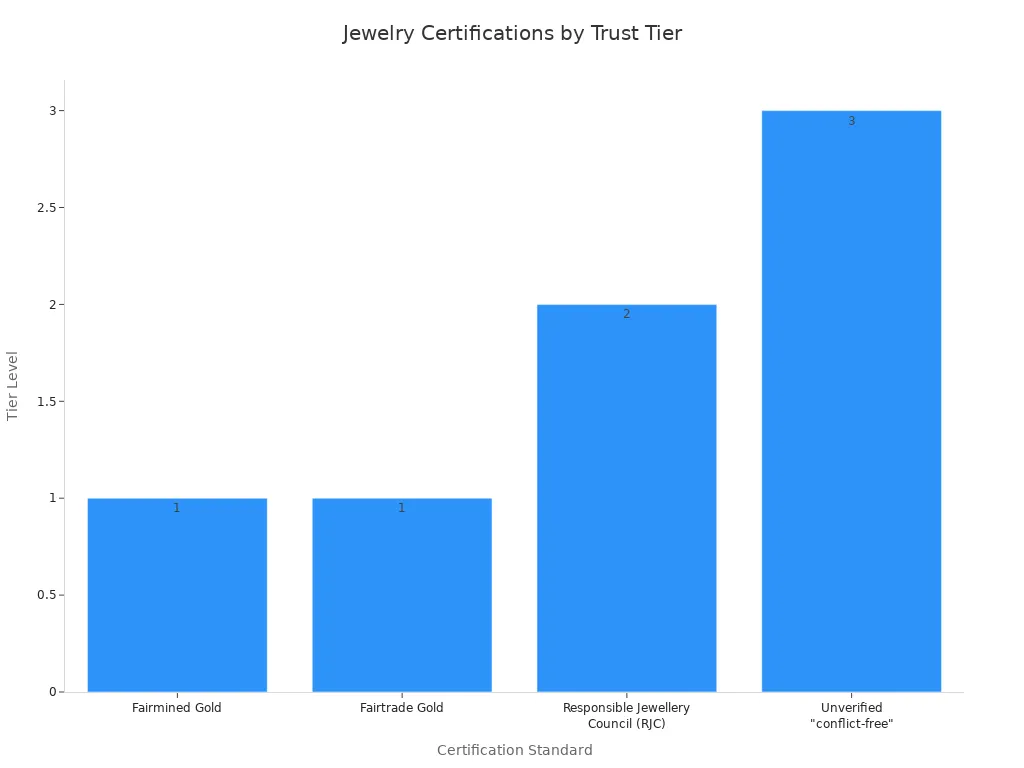
Brands select certifications based on their sourcing priorities and target customers. The following table outlines common certification tiers.
| Tier | Example Standard | What It Verifies | Best For |
|---|---|---|---|
| 1 | Fairmined Gold | Mining conditions, fair pay, traceability | Buyers prioritizing miner welfare |
| 1 | Fairtrade Gold | Artisanal mining standards, community development | Small-scale sourcing transparency |
| 2 | Responsible Jewellery Council (RJC) | Business ethics, labor, environment | Brand-level accountability |
| 3 | Unverified “conflict-free” | Nothing independently audited | Not a real guarantee |
Communicating Certifications Without Overpromising
Brands must communicate certifications honestly to avoid greenwashing. They should request current audit reports with issue dates to confirm certifications remain active. Contacting certification bodies directly verifies membership status. Reviewing public registries, such as those from RJC, confirms current members. Certified ethical jewelry requires verified ethical sourcing, not just self-assessment. Brands that admit uncertainty when needed build more trust than those making sweeping claims.
The Limits and Challenges of Jewellery Supply Chain Transparency
Where Traceability Still Falls Short
Gaps in Small-Scale and Artisanal Supply Chains
Artisanal miners work across shifting locations with informal record-keeping. Standard audit methods designed for large mines do not transfer easily to these operations. Certified refiners sometimes process blended batches, so final-product certification overstates actual integrity. The Responsible Jewellery Council and Fairmined have protocols, yet enforcement gaps persist where regulatory oversight is weak. A retailer may hold RJC membership while sourcing from non-certified suppliers unless it specifically holds Chain of Custody certification. This means certification may cover only one segment rather than the full jewellery supply chain.
Sourcing gold from the artisanal and small-scale mining sector in Colombia can be complex. With increasing national and international norms and regulations for the extraction and trading of gold, buyers can face many challenges in finding legal, formal, traceable, conflict free and responsible sources of gold.
Mixed-Origin Materials and Aggregated Gold
Aggregated gold mixes material from many sources. This practice makes complete traceability nearly impossible. A single piece may contain metal from multiple mines across different countries. Each source carries distinct ethical and environmental risks. Buyers cannot separate responsible gold from questionable gold once refiners melt them together.
Certification Isn’t a Cure-All
Enforcement and Audit Fatigue
The RJC announces its audits in advance, which could limit the reliability of what auditors find. Auditors have ESG compliance training but rarely the technical expertise to evaluate the colored-gem sector. Membership is not the same as certification. Certification can take up to two years, so members can tout affiliation before doing the work. Fairmined and Fairtrade Gold reach only a fraction of the wider industry despite their stringent, in-person mine assessments. Global Witness left the Kimberley Process, stating voluntary schemes are not going to cut it.
Greenwashing Within Certified Frameworks
Certification is a baseline, not a guarantee. The RJC is described as a strong baseline but not a guaranteed solution. The shift from strengthened standards to consistent, high-quality implementation on the ground is the most critical next step. Large, well-resourced companies can afford certification costs far better than smaller players, who make up the bulk of the industry.
The Cost Factor for Buyers and Brands
Why Ethical Sourcing Can Raise Prices
Ethically sourced jewelry often carries a higher price tag. This reflects the genuine cost of responsible business. Jewelers who adopt ethical practices invest in fair wages for miners and artisans, safer working conditions, and environmentally sound processes. These increased operational costs raise the price buyers pay and increase costs for brands.
Balancing Budget With Values
Buyers must weigh their values against their budgets. A transparent supply chain costs more to build and maintain. Smaller jewelers may lack resources to adopt and maintain blockchain systems. Some also fear that transparency could disrupt traditional business practices where secrecy in sourcing is valued. Buyers who understand these trade-offs can make informed choices that align with both their ethics and their financial reality.
How to Spot Genuine Transparency in Sourcing as a Buyer

Buyers hold more power than they realize. Every question asked, every document requested, and every brand chosen sends a signal through the market. The following guide helps buyers separate genuine transparency in sourcing from polished marketing language.
Questions to Ask Before You Buy
A buyer who asks the right questions gains immediate clarity. Brands that practice real transparency answer without hesitation. Brands that rely on vague promises often stumble.
Origin, Certification, and Labor Practices
Buyers should start with the stone itself. They can ask where the stone was mined or grown. They can ask which refiner processed the gold. They can ask whether the diamond is antique or newly mined. These questions establish the foundation of any verifiable origin story.
Labor practices matter just as much as origin. Buyers should ask what conditions workers faced at the mine and the cutting facility. They should ask whether the retailer has adopted the Jewelers of America “Social, Ethical, and Environmental Statement of Principles.” This trade association framework gives buyers a concrete standard to reference.
Buyers should not assume that synthetic gems are automatically more responsible. Lab-grown stones may also be cut under unhealthy conditions by workers paid starvation wages. Buyers should ask where and under what conditions synthetic gems were cut. This question applies the same scrutiny to lab-grown and mined materials.
A useful set of questions includes the following:
- Where was this stone mined?
- Which refiner processed the gold?
- Is this diamond antique or newly mined?
- Can I see the audit report?
- Which refiner processed this metal?
- Can I see the chain-of-custody statement for this batch?
- Is the recycled content certified by a third party, or self-declared?
- Does the certification apply to this piece, or only to the brand’s overall sourcing?
These questions push the conversation beyond marketing. They demand specific, checkable answers. A brand that answers them earns immediate credibility.
Requesting Documentation and Proof
Documentation turns claims into facts. Buyers should request third-party certifications such as RJC or Fairmined. They should ask for a supply chain document or blockchain tracking record specific to their piece. Marketing language is not a substitute for documentation.
Several documents provide verifiable traceability. A Kimberley Process Certificate confirms the shipment is not from a conflict zone, but it does not cover labor, environment, or cutting conditions. A refiner’s chain-of-custody statement names the refinery and confirms the metal’s origin or recycled content. Supplier declarations provide written statements from cutters, dealers, or setting workshops confirming origin and handling. Audit summaries give a certifying body’s report on the business practices of a supplier in the chain. Invoices and shipping records let an auditor reconstruct the journey.
For diamond purchases, a GIA certification is non-negotiable. It provides an objective, internationally recognized quality baseline and helps preserve resale value. A professional appraisal establishes monetary value and should include a complete item description, current replacement value, multi-angle photographs, appraiser credentials and methodology, and the date of valuation. Buyers should also keep a personal purchase archive with original receipts and invoices, seller information and warranties, payment documentation, high-quality photos or videos, and provenance records for inherited pieces.
A proper bill of sale should clearly record buyer and seller, the piece, the agreed price, and the date. If buying or selling regularly, buyers may also request a business license, resale certificate, or sales tax permit. These documents create a complete record that supports informed, values-driven buying decisions.
Reading Between the Lines of Brand Claims
Marketing language often sounds ethical without providing proof. Buyers who learn to read between the lines protect themselves from greenwashing.
Red Flags in Sustainability Messaging
Certain phrases signal a lack of real transparency. Vague terms like “eco-friendly” without a named certification body are a greenwashing signal. The following table outlines common red flags and their examples.
| Red Flag | Description | Examples |
|---|---|---|
| Vague or Unverified Claims | Broad sustainability statements lacking specific details or proof | “Responsibly made” without production process explanation; “Green” or “eco” without clarifying environmental benefits; “Natural” for metals; Generic sustainability symbols without proof |
| Lack of Transparency in Sourcing | Brands avoid disclosing where materials come from or fail to provide traceability | No information on metal origins; No documentation for gemstone sources; No certifications for materials; Inability to answer supply chain questions |
| Overemphasis on Single Sustainability Factor | Focusing on one positive aspect while ignoring other unsustainable practices | Advertising recycled metals but using toxic chemicals in plating; Carbon-neutral shipping claims ignoring manufacturing emissions; Conflict-free diamonds without addressing environmental impact; Fair trade gold without considering other materials |
| Fake or Misleading Certifications | Certifications that appear credible but lack substance or comprehensive evaluation | RJC certifying companies as a whole rather than products; Kimberley Process focusing only on conflict prevention, not environmental or labor issues |
| Deceptive Marketing Terms | Buzzwords designed to sound ethical without solid evidence | “All-natural,” “eco-friendly,” “green” without proof; “Diamonds made entirely from the sky”; “Real diamonds” or “sustainable diamonds” without clarifying synthetic or lab-grown origin; Labeling jewelry as “vegan” as a superficial eco-conscious attempt |
Buyers should also watch for vague promises and claims. Brands may claim to be sustainable, ethical, fair trade, or eco-friendly without specific, verifiable information about sourcing, materials, labor practices, or environmental impacts. Some brands focus excessively on recycled materials to appear sustainable while obscuring other unsustainable practices. They may use recycled gold without traceability of origin, ignore hazardous chemicals in manufacturing, or fail to address unethical mining practices. Poor or absent traceability represents another red flag. If a brand cannot provide information on mines, recycling plants, or communities involved in the supply chain, buyers should treat the claim with caution.
The following table lists vague sustainability language and why it signals a lack of transparency.
| Vague Sustainability Language | Why It Signals a Lack of Transparency |
|---|---|
| “Eco-friendly” | Used without proof or a named certification body; often a greenwashing signal. |
| “Ethical” | Thrown around without clear explanation or evidence to back it up. |
| “Sustainable” | Broad claim that lacks enough detail to verify genuine commitment. |
| “Responsibly made” | No explanation of the production process is provided. |
| “Green” / “Eco” | Specific environmental benefits are not clarified. |
| “Natural” (for metals/materials) | Ambiguous when applied to metals or other materials. |
| “Vegan” | Irrelevant ethical statement; most jewelry contains no animal products, so it is a superficial eco-conscious claim. |
| “Recycled metals or diamonds” | No sourcing details, processing methods, or percentage of recycled content specified. |
| “All-natural” | Raises a red flag if not backed by solid evidence or certifications. |
| “Sustainable diamonds” / “Real diamonds” / “diamonds made entirely from the sky” | Origin (synthetic, lab-grown, or lab-created) is not clarified. |
| Generic symbols or imagery implying sustainability | Imply sustainability without proof. |
Buyers should also watch for these specific phrases: “Eco-friendly” with no standard named, “Conflict-free” used without mentioning the Kimberley Process or an audit, “Ethically sourced” with zero supplier detail, a certification logo with no certificate number, and sustainability pages that talk about feelings rather than audits. If a brand cannot name the refinery or the mine region for a given stone, “ethically sourced” is a marketing term, not a verified fact.
Trusted Certifications and Databases to Check
Buyers can verify claims through independent databases. The following table summarizes the most trusted certifications and independent databases for checking jewelry origins.
| Certification / Database | Applies to | What it verifies | Independent verification |
|---|---|---|---|
| GIA | Natural diamonds | 4Cs grading; strictest nonprofit lab | GIA Report Check (gia.edu/report-check) |
| IGI | Lab-grown diamonds | Standard lab-grown certification; ~70% market share | IGI Verify (igi.org/verify) |
| AGS | Diamond cut / light performance | Cut precision using 0–10 scale; merged with GIA | AGS Verify (americangemsociety.org/verify) |
| RJC | Jewelry supply chains | Human rights, labor, environment, ethics; independent audit required | RJC member audit |
| Kimberley Process | Rough diamonds | Conflict-free origin; government-issued; rough diamonds only | Government/import documentation |
| Fairmined | Artisanal gold | Fair wages, environmental protection, zero child labor | Fairmined third-party certification |
| ISO 9001/14001 + SEDEX | Brands/manufacturers | Quality management, environmental management, supply-chain transparency | Audited compliance / SEDEX membership |
For direct online verification, buyers can use GIA Report Check, IGI Verify, and AGS Verify as the official portals to enter report numbers before purchase. These tools provide immediate confirmation of a stone’s grading and origin claims.
The following table outlines what each major certification body covers.
| Certification Body | What It Covers |
|---|---|
| Responsible Jewellery Council (RJC) | Audits business practices, labor, and sourcing across the entire supply chain |
| Fairmined | Focuses on artisanal and small-scale mining communities |
| Fairtrade Gold | Sets a minimum price and premium for small miners |
| Kimberley Process | Government-backed scheme to block conflict diamonds |
| SCS Global Services | Verifies recycled and responsibly sourced precious metals |
Buyers who check these databases gain confidence in their purchases. They move from trusting a brand’s word to verifying its claims.
Choosing Brands That Walk the Talk
A brand’s actions over time reveal its true commitment. Buyers can look for specific signs that separate genuine ethical sourcing from performative gestures.
Signs of Long-Term Commitment
Long-term commitment shows through structural, ongoing practices. The following table presents these markers.
| Sign of Long-Term Commitment | How It Manifests |
|---|---|
| Open, traceable sourcing | Ethical brands reveal where gemstones and precious metals originate and provide provenance details so conflict-free claims can be checked. |
| Labor rights protection | Ethical sourcing ties to safe working conditions, fair pay, and respect for workers’ rights across the supply chain. |
| Third-party verification | Fairtrade and Fairmined certification and the Kimberley Process provide external checks of responsible sourcing. |
| Lower-impact materials | Brands use reclaimed precious metals, certified Fairmined or Fairtrade gold, verified conflict-free diamonds, lab-grown stones, and responsibly mined natural gems. |
| Community and craft preservation | Brands work with local small-scale miners and artisans, ensuring fair compensation and continuing traditional jewelry techniques. |
| Public sourcing policies | Brands state their material standards and disclose traceability, origins, and provenance. |
These indicators are structural and ongoing. They signal long-term commitment rather than one-time claims. A brand that publishes annual sourcing reports, maintains active certifications, and updates its policies demonstrates real dedication.
Supporting Smaller Ethical Jewelers
Smaller jewelers often face barriers to certification. Certification can take up to two years, and large, well-resourced companies can afford certification costs far better than smaller players. Buyers who want to support ethical practices can look for smaller jewelers who work directly with artisanal miners or use Fairmined and Fairtrade Gold.
These smaller operations may lack blockchain systems or extensive marketing budgets. They may still provide chain-of-custody statements, supplier declarations, and direct relationships with mining communities. Buyers can ask about these practices and support jewelers who demonstrate genuine effort.
Consumers play a critical role in driving change. Most businesses will only change their policies once they see demand for more responsible products. Jewelry buyers should let retailers know they are concerned about issues surrounding gemstone production and ask what retailers are doing to address those concerns. This feedback loop pushes the entire industry toward greater transparency.
Buyers who prioritize responsibly sourced jewelry and ask hard questions create market pressure. That pressure rewards brands that invest in transparency and penalizes those that rely on opacity. Every purchase becomes a vote for the kind of industry the buyer wants to support.
The Future of Jewelry Supply Chain Transparency
Rising Consumer Expectations
Gen Z and the Demand for Radical Honesty
Gen Z buyers treat transparency as a baseline requirement, not a bonus. They grew up with instant information access and expect brands to match that reality. Sixty-five percent of consumers now demand supply-chain proof, and early blockchain adopters gain competitive advantage as buyers increasingly expect verifiable sourcing. This generation rewards brands that disclose origins, labor conditions, and environmental impact without waiting to be asked.
Social Media as an Accountability Tool
Social media amplifies buyer scrutiny. A single post can expose a brand’s vague claims to millions of viewers. Consumers increasingly require supply-chain transparency, environmental impact disclosure, and fair-labor verification. Brands that cannot answer hard questions face public backlash. This pressure makes accountability a daily practice rather than an annual report.
Innovations on the Horizon
AI and Satellite Monitoring in Mining
Global Witness and other organizations use satellite imaging analyzed by machine learning to detect illegal mining operations, deforestation, and other environmental risks. These tools can also verify whether mining sites claiming to be closed or rehabilitated are actually inactive. Companies committed to ethical sourcing now integrate these tools to audit their supply partners. AI-powered systems can automatically analyze supplier data, flag risks, and scan shipping documents for inconsistencies. Tools like IBM’s Blockchain Transparent Supply support ethical certification and automate due diligence across the jewellery supply chain.
Universal Digital Provenance Standards
Blockchain is becoming the verification standard for tracing materials from source to finished product. NFC chips, QR codes linked to provenance data, and blockchain immutable records will support traceability over the next decade. Third-party standards such as RJC, Fairtrade Gold, and Kimberley Process remain important for verifying ethical claims.
| Future trend | Supporting evidence |
|---|---|
| Blockchain verification | Blockchain is becoming the verification standard for tracing materials from source to finished product. |
| Consumer demand for proof | 65% of consumers demand supply-chain proof, and early blockchain adopters gain competitive advantage. |
| Supply-chain disclosure | Consumers increasingly require supply-chain transparency, environmental impact disclosure, and fair-labor verification. |
| Tracking technologies | NFC chips, QR codes linked to provenance data, and blockchain immutable records support traceability. |
| Certifications | Third-party standards such as RJC, Fairtrade Gold, and Kimberley Process remain important. |
Transparency as the New Luxury Standard
Why Opacity Will Soon Be a Dealbreaker
Opacity will soon end brand loyalty. Buyers who cannot verify a claim will walk away. When supply chain transparency becomes essential, brands that hide their sources lose trust and market share. The jewellery supply chain transparency movement has reached a tipping point where silence signals guilt.
How Ethical Sourcing Redefines Prestige
Transparency in jewelry sourcing now defines prestige. A ring with a verifiable story carries more value than one with a vague promise. Ethical sourcing turns a purchase into a statement of values. Brands that embrace transparency earn loyalty, trust, and a lasting place in the hearts of conscious consumers.
Transparency in sourcing is not a trend. It is a fundamental shift in what buyers expect and what brands must deliver. When buyers know where their jewelry comes from, they endorse the people and practices behind it. Modern buyers shape the industry through their choices, questions, and loyalty. Brands that embrace transparency earn trust and a lasting place in the hearts of conscious consumers. Ultimately, transparency turns a purchase into a statement of values. That is the true luxury of modern jewelry.
FAQ
What does transparency in jewelry sourcing mean?
Transparency in jewelry sourcing means a buyer can trace a gemstone or metal from mine to market. It reveals where materials originate, who handles them, and what standards apply at each stage. This visibility lets buyers verify ethical and environmental claims before purchase.
Why do modern buyers care about supply chain transparency?
Modern buyers want their purchases to reflect their values. They avoid funding conflict, forced labor, and environmental harm. Transparency gives them proof that their jewelry aligns with ethical standards. This concern now shapes mainstream shopping behavior across generations.
What is the Kimberley Process, and is it enough?
The Kimberley Process certifies that rough diamonds are not from conflict zones. However, it does not cover labor conditions, environmental impact, or cutting practices. Buyers who want full ethical assurance need additional certifications beyond Kimberley Process.
How can buyers verify a brand’s ethical claims?
Buyers can request third-party certifications such as RJC or Fairmined. They can ask for chain-of-custody statements and audit reports. Checking databases like GIA Report Check or IGI Verify confirms diamond grading. Documentation turns marketing claims into verifiable facts.
What are red flags in sustainability messaging?
Vague terms like “eco-friendly” or “ethically sourced” without proof signal greenwashing. Brands that cannot name their refinery or mine region raise concern. Missing certification numbers or generic sustainability symbols also indicate a lack of real transparency.
Why does ethical sourcing sometimes cost more?
Ethical sourcing requires fair wages, safe conditions, and environmental protections. These practices increase operational costs for brands. Buyers who value transparency understand that higher prices reflect responsible business practices rather than inflated margins.
What technologies help track jewelry origins?
Blockchain creates tamper-proof records of a stone’s journey. QR codes and digital passports let buyers scan a piece and see its provenance. AI and satellite monitoring detect illegal mining. These tools make verification faster and more reliable for consumers.
Will transparency become a standard expectation?
Yes. Consumer demand for supply chain proof keeps rising, especially among younger buyers. Brands that hide their sources will lose trust and market share. Transparency will soon define prestige in the jewelry industry.
See Also
How To Lower Carbon Emissions Across Your Jewelry Supply Chain
The Rising Popularity Of Matte Finishes In Contemporary Jewelry Branding
Strategies For Promoting Your Jewelry Brand’s Sustainable And Eco-Friendly Commitment
An In-Depth Exploration Of The Sustainable Jewelry Packaging Industry
The Ultimate Guide To Sustainable And Eco-Friendly Jewelry Packaging