Bulk buyers of a jewelry drawer organizer should check four main specs before they sign off. These are export carton dimensions, per-carton weight limits, inner packaging materials (polybags, dividers, moisture barriers), and carton labeling. Most master cartons are 50–60 cm long, and weight caps are set to protect the product and meet carrier handling limits.
These specs change with construction. Velvet and suede surfaces need tissue wrap and dividers, while microfiber and PU leather need polybag barriers. Order volume also changes pallet and carton setup. Tongxing Packaging Co., Ltd. gives a written packing spec sheet with every bulk order, so buyers can check a quotation or draft a purchase order against real numbers and standards.
Die wichtigsten Erkenntnisse
- Check four main packing specs before you order: carton size, weight limits, inner packaging, and labels.
- Match the inside packaging to the organizer’s material: velvet needs tissue and dividers, while PU leather needs polybags.
- Keep the carton weight within carrier limits. This protects the product and keeps shipping costs low.
- Use clear carton marks and the right documents to avoid customs delays and extra fees.
- Ask for a sample carton and test record before you place a bulk order. This will confirm that everything meets your needs.
Export Carton Specs for a Jewelry Drawer Organizer
Standard Dimensions and Board Grades
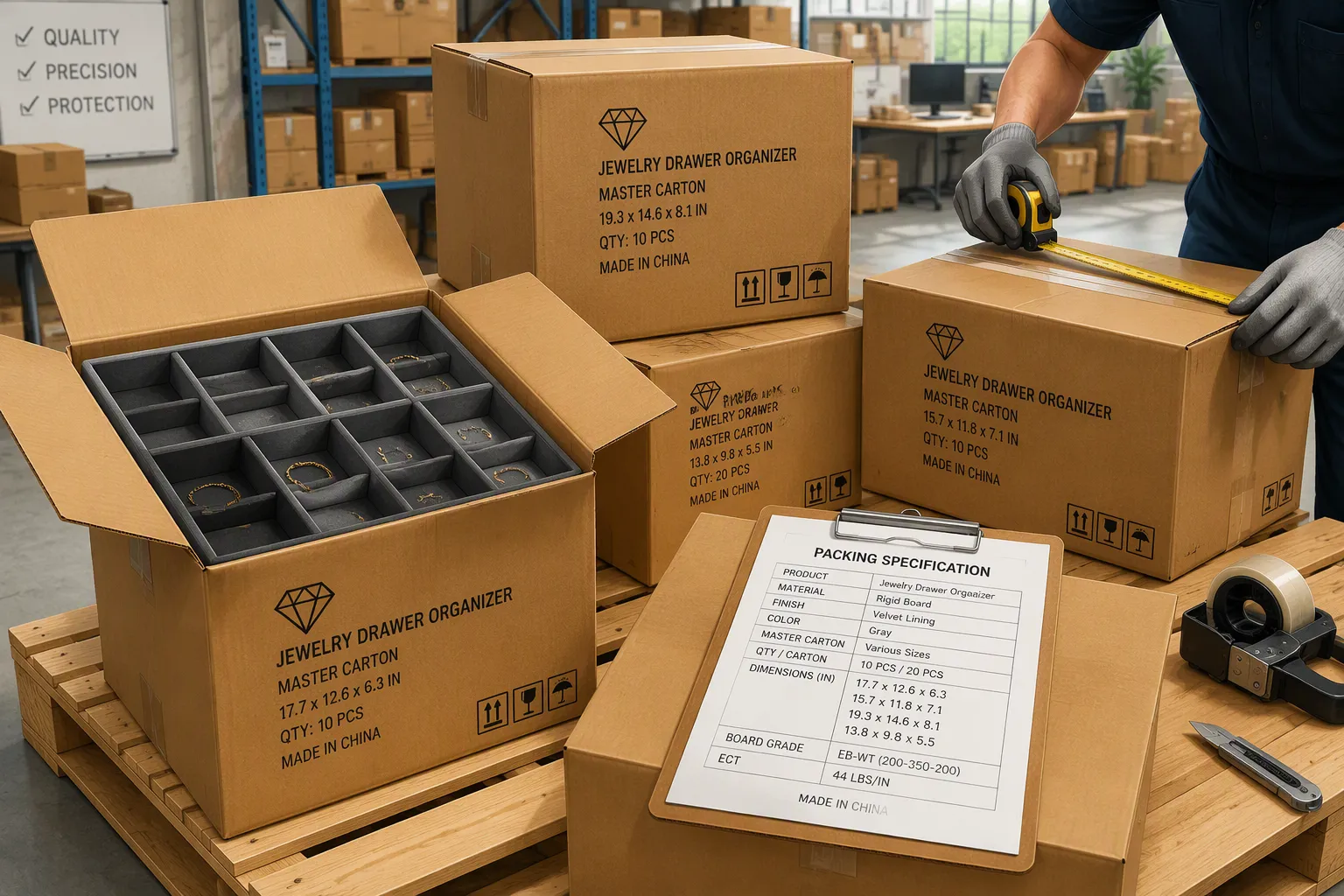
Most export master cartons for a jewelry drawer organizer are 50–60 cm long. Width and height depend on the organizer format. A flat folding organizer needs a shallow carton. A partitioned travel box with stacked compartments needs a taller one. Tongxing Packaging Co., Ltd. writes the exact length, width, and height for each SKU on the packing spec sheet. That way, the buyer sees the same numbers the factory uses on the line.
Board grade depends on the load. Single-wall corrugated board works for lighter cartons, like snap pouches and small velvet organizers packed in low stacks. Double-wall board works for heavier master cartons, like multi-compartment drawer organizers or mixed cartons with dense sponge cores. Double-wall board holds up better against compression in tall stacks and long ocean trips. The factory matches board grade to carton weight and stacking height instead of using one grade for every order.
Organizer size and compartment count change the carton footprint. A buyer who packs 20 small ring organizers per carton gets a different footprint than a buyer who packs 10 large drawer organizers with eight compartments each. More compartments mean more internal structure, so each unit takes up more space. Tongxing Packaging checks dimensions against a physical sample before production. The factory also customizes carton specs on request, including printed cartons, custom dimensions for pallet fit, and reinforced corners for fragile setups.
Weight Limits per Carton
Per-carton weight limits protect two things: the product inside and the people who handle the carton. Carriers set handling limits, and warehouses set manual lifting limits. Tongxing Packaging caps each carton so it stays within those limits while still shipping at a good cost. The cap depends on construction. Velvet and suede organizers are light, so a carton can hold more units. PU leather cases with thick sponge cores weigh more per unit, so the carton holds fewer.
Compartment count also affects the cap. A jewelry drawer organizer with many small dividers adds material weight without adding much product value per gram. The factory weighs a filled sample carton and sets the unit count from that result. Buyers get the per-carton quantity, gross weight, and net weight on the spec sheet. These figures let the buyer figure out total shipment weight before booking freight. Tongxing Packaging adjusts unit counts per carton when a buyer needs a specific pallet weight or a specific container load.
Inner Packaging and Product Protection
Dividers, Polybags, and Moisture Control
Inner packaging does the real protective work in a bulk shipment. The master carton takes the outside handling, and the inner layers keep each organizer clean, uncrushed, and free of surface marks. Tongxing Packaging Co., Ltd. matches the inner pack to the surface material, because a velvet face and a PU leather face fail in different ways.
| Surface material | Primary inner protection | Reason |
|---|---|---|
| Samt | Tissue wrap plus rigid dividers | Prevents pile crushing and pressure marks |
| Wildleder | Tissue wrap plus dividers, no direct contact | Protects nap and avoids shine marks |
| Mikrofaser | Polybag barrier plus dividers | Blocks dust and rubbing during transit |
| PU leather | Polybag barrier | Prevents scuffing and plasticizer transfer |
Velvet and suede organizers need tissue wrap and dividers. The tissue stops the pile from flattening against the carton wall. Dividers keep each unit apart, so one organizer does not press into the next. Microfiber and PU leather need polybag barriers instead. A polybag keeps dust off the surface and stops two units from rubbing together. Moisture control matters for every material. The factory can add desiccant packs inside the master carton for long ocean routes or humid destinations.
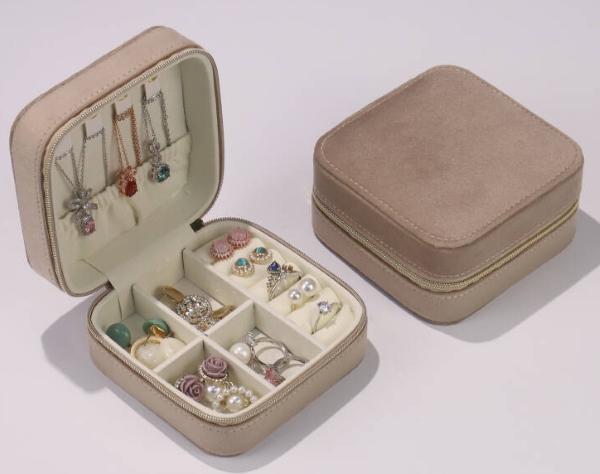
Each format nests in its own way. A folding organizer lies flat and stacks in shallow layers. A partitioned travel box stands upright, with dividers between rows. A snap pouch with a debossed logo sits in a small tray insert, so the logo faces up and stays free of contact. Buyers who order a jewelry drawer organizer with many compartments get a fitted insert that mirrors the unit footprint.
Drop-Test and Stacking Requirements
Drop testing checks the packed carton, not just the product. The factory drops a filled master carton from handling height onto a hard surface and inspects the contents for shifted dividers, cracked corners, and surface damage. Stacking, or compression, testing checks the carton under load. A carton at the bottom of a tall pallet carries the weight of every carton above it, so the board grade and inner dividers must hold shape through a full container trip.
Tongxing Packaging runs these checks against ISTA-style transit protocols and records the results. The packing spec sheet notes the drop height, the stack load, and the pass result for each SKU. Buyers can request the test record with the quotation. This step matters most for partitioned travel boxes and thick-sponge microfiber organizers, where internal structure carries the load.
Labeling, Marking, and Shipping Documents
Carton Marks and Barcode Standards
Carton marks tell every handler what is inside the box and where it belongs. Tongxing Packaging Co., Ltd. prints shipping marks on two sides of each master carton. The marks show the buyer’s company name, the PO number, the SKU code, the carton serial number, the gross and net weight, and the carton dimensions. A serial number such as 1 of 24 lets a warehouse count cartons against the packing list without opening a single box.
Barcode standards follow the GS1 General Specifications. The factory prints a GS1-128 or ITF-14 barcode for the carton identifier. It keeps the symbol clear of seams, corners, and tape lines. ISO 15394 covers where transport labels go and how good they must be. Tongxing Packaging checks print contrast and quiet zones before the run starts. Buyers who ship to retail distribution centers should send their own label template with the order. The factory then applies the retailer’s barcode and label placement rules on the line.
Invoice and Packing List Essentials
The commercial invoice and packing list must match the carton marks exactly. The invoice lists the product description, the HS code for jewelry organizers, the quantity, the unit price, the total value, the country of origin, and the Incoterms term. The packing list lists carton count, per-carton quantity, net weight, gross weight, and carton dimensions. One mismatched weight between the two documents can hold a container at customs.
Tongxing Packaging Co., Ltd. issues both documents with the packing spec sheet, so the buyer checks one set of numbers against another. The factory also prepares the certificate of origin and any test report the destination market requires. Buyers should confirm the consignee name, the notify party, and the port of discharge before production ends. A short review at that stage prevents reprinting labels and reissuing documents later.
Compliance, Testing, and Freight Cost
Material and Transit Testing Standards
Compliance begins with the materials. Velvet, suede, microfiber, and PU leather each have their own test requirements. Tongxing Packaging Co., Ltd. keeps records for every surface it ships. The factory checks colorfastness, surface abrasion, and seam strength on a sample from each production lot. Buyers who sell through retail channels often need these records for their own supplier files.
Transit testing then shows that the packed carton can survive the trip. The factory runs a drop test from handling height. It also runs a stacking, or compression, test under a simulated pallet load. Both follow ISTA-style protocols. Tongxing Packaging records the drop height, the stack load, and the pass result for each SKU on the packing spec sheet. A recent buyer of partitioned travel boxes asked for compression results before booking ocean freight. The factory sent the test record with the quotation, and the buyer approved production without a second sample round.
How Packing Affects Freight Cost
Carton size, carton weight, and pallet setup drive freight cost in both shipping modes. A carton that fits the pallet footprint without overhang uses container space well. An oversized carton wastes volume and raises the chargeable weight. Tongxing Packaging reviews pallet layouts with each buyer. It adjusts carton dimensions where the change does not hurt product protection.
| Mode | Best fit | Packing lever |
|---|---|---|
| LCL | Smaller volumes, mixed SKUs | Tight carton dimensions, low carton count |
| FCL | Full container volumes | Pallet configuration, stack height |
Neither mode is better in every case. LCL suits a buyer testing a new organizer line with a modest order. FCL suits a repeat buyer with steady volume and a full container load. In one project, Tongxing Packaging trimmed a carton to match the pallet footprint exactly. The change cut wasted space per pallet and lowered the buyer’s freight charge without touching the inner protection.
A buyer’s checklist covers five items: carton dimensions and board grade, per-carton weight caps, inner protection matched to velvet, suede, microfiber, or PU leather, carton marks and shipping documents, and transit test records. Each item needs to be in writing before production starts.
A signed packing spec sheet from Tongxing Packaging Co., Ltd. takes care of these points early. It protects the buyer from damage claims, customs holds, and surprise freight charges. For any jewelry drawer organizer order, the next step is simple: ask for a sample carton and the spec sheet, check both, then place the bulk order.
FAQ
What carton size should a buyer expect for a bulk jewelry drawer organizer order?
Most master cartons are 50–60 cm long. The organizer format decides the width and height. A flat folding organizer ships in a shallow carton. A partitioned travel box needs a taller one. Tongxing Packaging Co., Ltd. lists exact dimensions for each SKU on the packing spec sheet.
How does the factory decide how many units go in one carton?
The factory first weighs a filled sample carton. Then it sets the unit count so the carton stays within carrier handling limits. Light velvet organizers allow more units per carton. Dense PU leather cases with sponge cores allow fewer. The spec sheet shows per-carton quantity, gross weight, and net weight.
Which inner packaging suits a velvet organizer versus a PU leather case?
Velvet and suede organizers need tissue wrap and rigid dividers. The tissue keeps the pile from flattening. Microfiber and PU leather need polybag barriers to block dust and scuffing. Desiccant packs help on long ocean routes or humid destinations.
What do the carton marks and barcodes include?
Each master carton shows the buyer’s company name, PO number, SKU code, carton serial number, weights, and dimensions on two sides. The factory prints a GS1-128 or ITF-14 barcode under the GS1 General Specifications. Label placement follows ISO 15394.
Can a buyer request a sample carton and test record before committing to a bulk order?
Yes. Tongxing Packaging Co., Ltd. supplies a sample carton and the written packing spec sheet on request. The sheet records drop-test and stacking results under ISTA-style protocols. Buyers can check dimensions, weights, and inner protection against the quotation before placing the order.