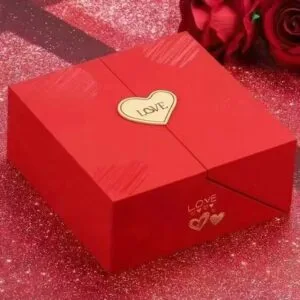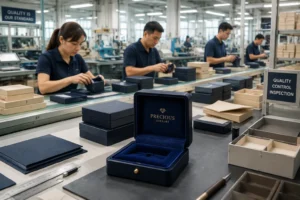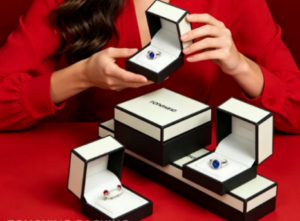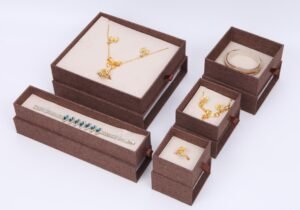
Typical factory MOQs for custom jewelry boxes are in the 200–1,000 unit range. Some factories take a smallest production order near 100 pieces for fully custom rigid structures. Others quote about 500 units per size or season. Setup costs, tooling, and material yield drive these MOQs, not factory inflexibility. The number changes with box type and customization level. Standard rigid boxes sit at the higher end. Simpler structures allow a low MOQ. A low quantity raises the per-unit price, so buyers weigh volume against budget. Custom packaging suppliers set each MOQ from these economics.
Κύρια συμπεράσματα
Most factories ask for orders of 200 to 1,000 units for custom jewelry boxes.
Setup costs and material yield set minimum order quantities, not factory inflexibility.
Basic box designs can have lower MOQs, sometimes as low as 100 units.
Bigger orders lower the cost of each unit by spreading out fixed costs.
Brands can use stock boxes, custom labels, and digital printing to order less than the usual MOQs.
Why Typical MOQ for Custom Jewelry Boxes Starts at 200–1,000 Units
Factories do not pick an MOQ by chance. The number comes from two cost facts: setup work that happens once per run, and materials that come in fixed mill amounts. Both forces push the typical MOQ for custom jewelry boxes into the 200–1,000 unit band.
Setup Costs and Tooling
Every production run has fixed setup items. These include dielines, printing plates, foil stamps, embossing plates, sample testing, and machine calibration. A factory pays for them once, whether the run is small or large. Each item is a one-time cost for that design. The minimum order quantity exists because that fixed cost must go somewhere. The factory spreads it across the total quantity, so a small run carries a heavy share per box.
Machine calibration for a new rigid box size can take 2–4 hours of technician labor. A foil-stamping plate costs the same whether the factory stamps 1 box or 10,000 boxes. A run of only 50 boxes would push setup alone to about $20 per box. That math explains why suppliers often suggest starting around 500 pieces. The same logic applies to die-cut molds and handcraft labor.
Order Quantity | Estimated Unit Cost |
|---|---|
100 pcs | Very high |
500 pcs | More reasonable |
1,000 pcs | Stable |
5,000 pcs | Much lower |
The unit price of custom packaging usually drops when quantity increases because fixed costs are spread across more pieces. Mold fees, printing setup fees, machine setup, color adjustment, and sample preparation do not change much between small and larger runs. This is why 500 paper boxes may seem expensive, while 5,000 pieces may look much more reasonable per unit.
Around 500 units is the economies-of-scale threshold. Unit price can drop up to 40% versus a 100-unit run. A run of 1,000 pieces sits in a stable cost zone. This is why rigid setup boxes typically carry MOQs of 500–1,000 units.
A 300-unit order shows the same effect. Take luxury rigid boxes with special paper, hot stamping, an inner tray, and individual packing. The high unit price reflects fixed cost divided by few pieces, not too much supplier profit.
Material Yield and Production Efficiency
Material yield adds a second pressure. Paper, board, velvet, and specialty wraps come in mill minimums. High-end paper arrives in large master rolls. An odd box size creates unusable dead inventory, and the factory must absorb that waste. Offcuts from a small run rarely find a second use.
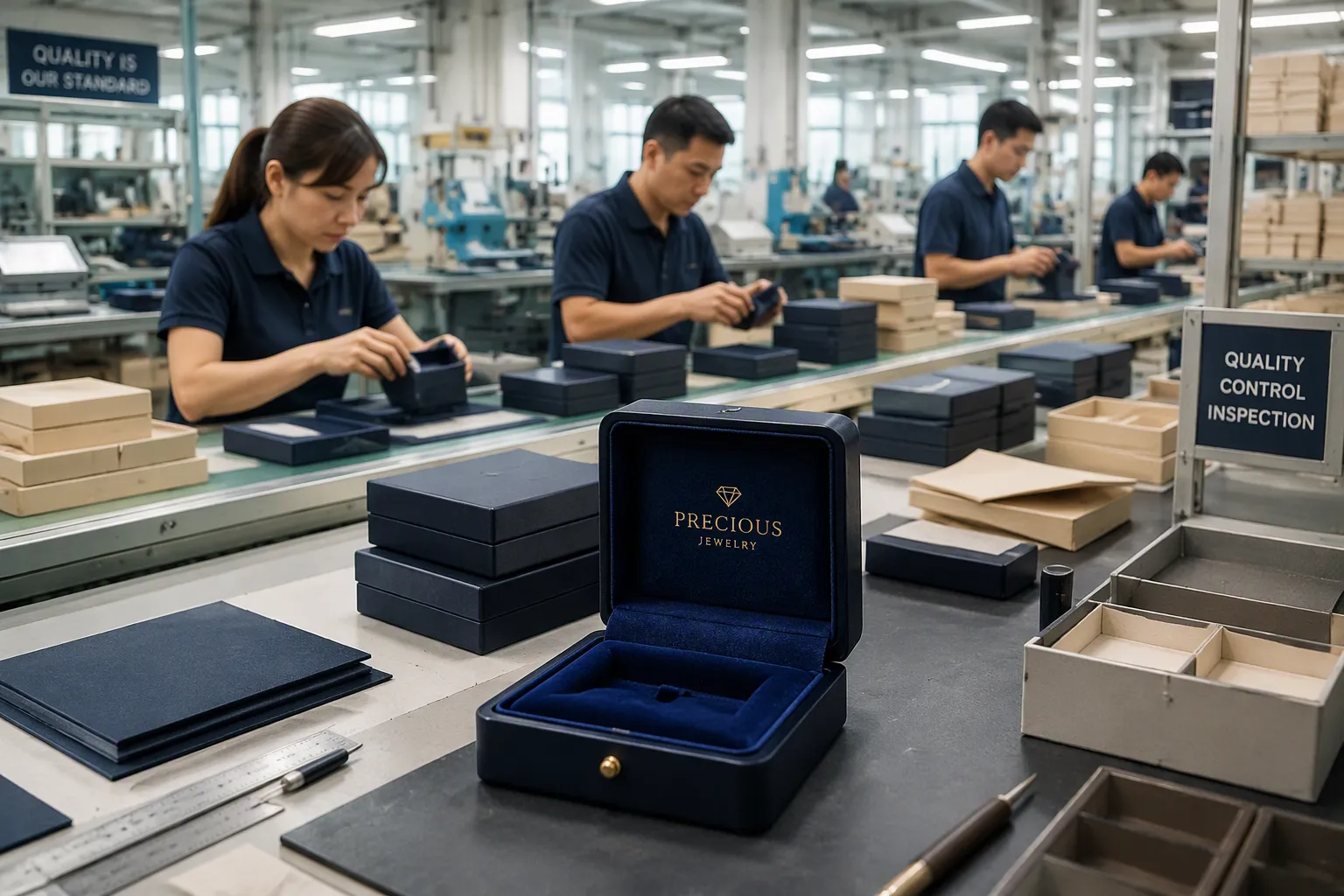
Small runs also raise handling cost per unit. Rigid boxes involve manual wrapping, magnet installation, insert assembly, glue drying, and inspection. Each step needs a minimum batch to run efficiently. Inspection alone takes time on every unit. A low MOQ raises the per-unit price, and a run near 100 pieces usually comes with a simpler structure. The 200–1,000 range reflects these economics, not supplier stubbornness.
Structure and material choice change the picture. A magnetic rigid box with a velvet insert needs more tooling than a plain lidded box. Tongxing Packaging Co., Ltd. builds both, and its team can explain the difference between paper, plastic, velvet, and wood constructions before quoting. A stock structure with custom finishing often fits a first run. Brands can review the custom jewelry boxes range and ask about MOQ tiers across the order quantity range to see the cost curve.
MOQ Ranges by Box Type and Customization
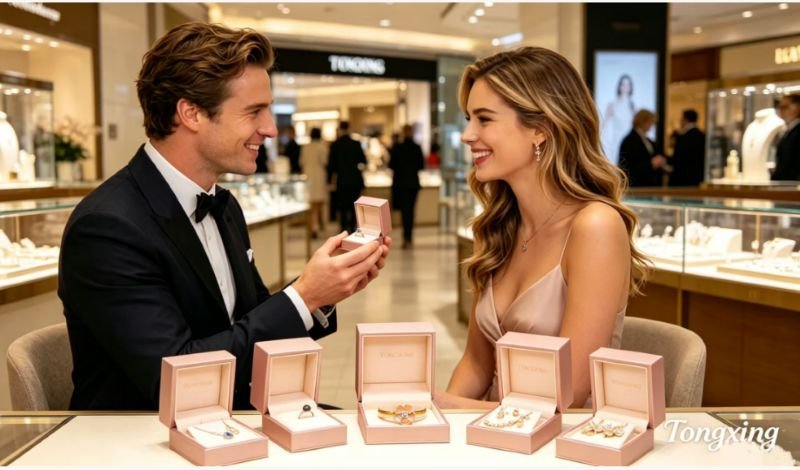
Box type and customization level change the MOQ more than anything else. A standard rigid box and a fully custom rigid jewelry box can be hundreds of units apart. Buyers who see the pattern can match their order to the right structure. This helps them avoid a quote that does not fit their budget.
Standard vs. Fully Custom Rigid Boxes
Standard rigid boxes often have MOQs of 300–1,000 units. These boxes use proven structures: a lidded base, a neck, and a simple insert. Factories already have the dielines, so setup work stays low. Setup boxes usually need 500–1,000 units because assembly takes many steps across base, lid, and insert. A 500-unit MOQ usually applies to one size and one color.
Fully custom structures work differently. Magnetic boxes, drawer boxes, and specialty shapes need new dielines and fresh machine calibration. Some factories quote as low as 100–200 pieces for these builds. That low number comes with a higher per-unit price, not a discount. Boxify Design notes that MOQs vary by supplier and material. Options range from small batches of 50 to 100 units up to bulk orders in the thousands. The range is wide, and the structure sets the floor.
Rigid structure changes the assembly path. A magnetic box needs magnet pockets and a folding lid. A drawer box needs a sliding tray and a stop. A specialty shape needs hand-wrapping around a custom corner. Each added part means another setup step. Each setup step lifts the minimum.
Material choice adds another layer. Paper wraps, board, velvet, and specialty wraps each carry different mill minimums. A velvet-lined run of custom jewelry boxes needs a fabric order that a plain paper box avoids. Size matters too. An odd size wastes board and raises effective quantity per design.
How Finishing and Inserts Affect MOQs
Finishing steps add tooling and setup work, and that pushes minimums upward. Foil stamping needs a metal plate. Embossing needs a matched die. UV coating needs a separate pass through the line. Each step is a fixed cost that a small run must absorb. Custom-dyed colors to a specific Pantone require a much higher MOQ, usually starting at 5,000 units.
Inserts follow the same rule. Foam, velvet, and molded pulp inserts each need their own cutting tools or molds. A stock insert fits many boxes. A molded insert fits one.
Factories build these options in-house. Custom structures include magnetic closures, drawer slides, ribbon pulls, and shaped lids. Finishing techniques include foil stamping, embossing, debossing, spot UV, and soft-touch lamination. Insert options include foam, velvet, molded pulp, and die-cut board trays. Each option carries its own tooling, so custom packaging minimums reflect the full build, not just the box shell.
The table below shows how order quantity tracks customization level.
Order Quantity | Customization Level | Ιδανικό για |
|---|---|---|
100–300 units | Logo stamp on stock colors/sizes | Testing market, soft launches |
500–1,000 units | Custom colors, custom inserts | Established Etsy shops, startups |
3,000–5,000 units | Full custom structural design | Scaling brands, wholesalers |
10,000+ units | Bespoke materials & automation | Global retailers, high-volume jewelry |
Stock and semi-custom options fit brands testing a design. A full custom rigid box fits established lines with predictable volume. Neither is better. Each one matches a different stage. Factories set moq requirements for rigid packaging from setup cost and material yield, and the box type simply changes where those costs land.
Navigating Low MOQs in Custom Jewelry Packaging
Real-World Low-Volume Order Example
A small jewelry brand needed roughly 300 units for a launch. The brand wanted a rigid box with its logo, but a full custom build carried a high per-unit price at that quantity. The team solved the problem in three ways. It chose a stock structure and added custom finishing, such as a foil logo on the lid. It bundled two ring and necklace sizes into one production run. It accepted a higher per-unit price to reach the low MOQ. The brand also tested a sample first and checked insert fit before approving the full run.
Suppliers now make this path easier. Pinlilabel sets a concrete threshold for small brands:
Q: What’s your MOQ? A: 100 pieces.
EcoPacki advertises a low minimum order quantity alongside fast quoting and design support, which lets small brands source custom rigid packaging in small batches. Some suppliers even offer custom order quantities, so buyers order only what they need.
Quality Trade-Offs to Watch
Below-standard MOQs narrow the scope rather than lower the quality. A low MOQ can mean fewer finishing options, longer lead times, higher unit costs, or fewer structural choices. Buyers should also plan for wear in daily use. Foil stamping can scuff on a hard edge, so a soft pouch protects the surface. A loose insert lets a ring shift, so the brand confirms tray depth at sampling. Laminated wraps resist moisture better than plain paper.
Stock boxes plus custom labels or sleeves suit very early-stage brands. A fully custom rigid box fits better once volume is predictable. Either way, a low-moq branding run carries a moq risk: unsold units tie up cash. Brands should match the quantity to realistic sales and treat the first order as a test.
Custom Packaging MOQ vs. Unit Cost
Order Quantity, Unit Cost, and Customization
How many units you order changes the unit cost in a way you can predict. Setup costs stay the same, so they get split across more units, and the price per unit drops as volume goes up. The table below shows how order quantity connects to approximate unit cost and the customization level each tier allows.
Order Quantity | Approximate Unit Cost | Customization Level |
|---|---|---|
100 units | Very high | Logo stamp on stock colors |
300 units | Υψηλό | Stock structure with custom finishing |
500 units | More reasonable | Custom colors, custom inserts |
1,000 units | Stable | Full custom finishing |
3,000 units | Much lower | Full custom structure and materials |
A 100-unit run puts a big share of the setup cost on each box. A 1,000-unit run spreads that same cost across ten times as many pieces. Buyers who plan around this curve avoid sticker shock. The custom packaging moq and the unit price move together, and smart moq planning starts with a realistic quantity estimate.
How Factories Lower MOQs
Factories use several methods to lower moqs without losing money. Modular stock structures reuse dielines the factory already has, so setup work drops. Shared dielines let several brands run the same box shape with different wraps. Digital printing replaces plate-based printing for short runs, which removes a fixed tooling cost. Consolidated material buying lets a factory combine orders for the same paper or board, which cuts mill waste.
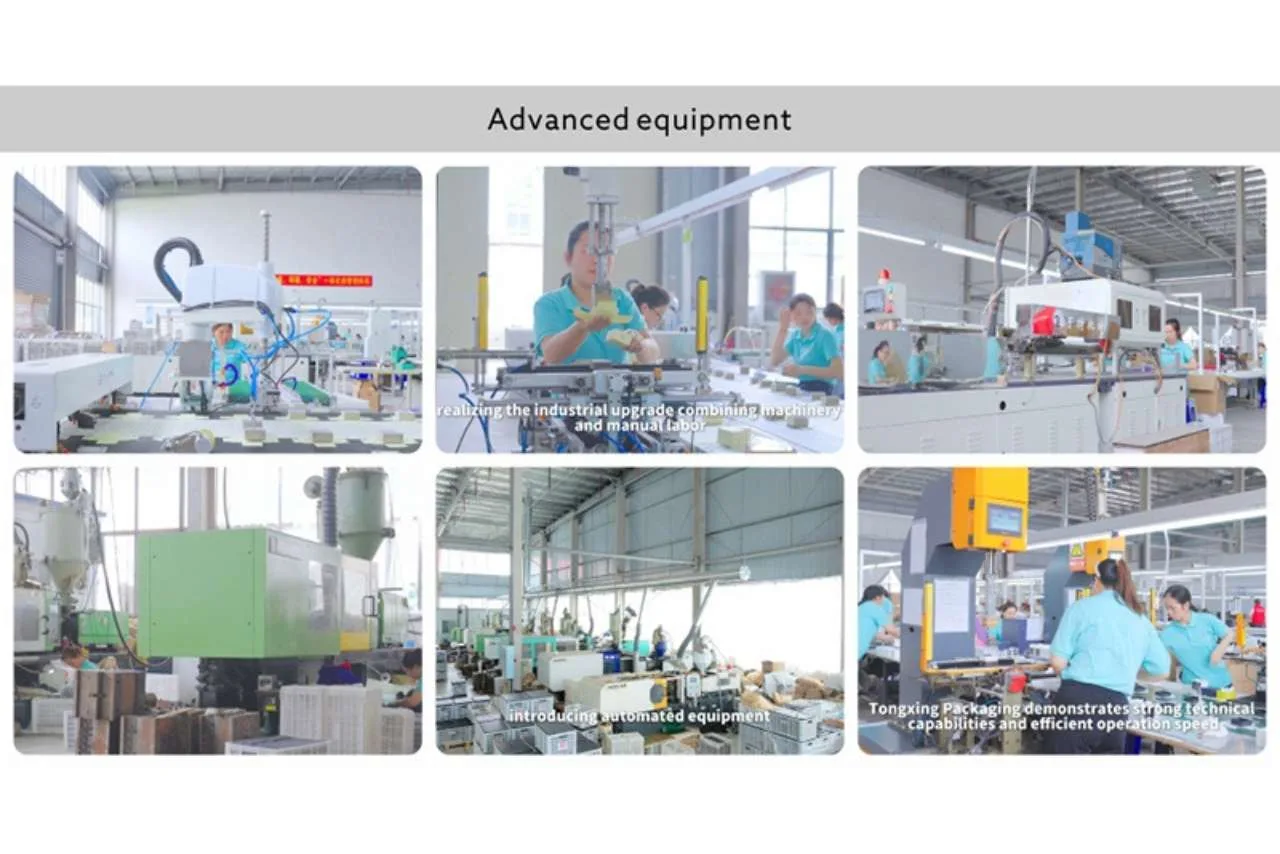
Tongxing Packaging Co., Ltd. uses these methods directly. Founded in 2003 and based in Shenzhen, the company runs a 10,000-square-meter workshop with more than 2,500 production staff, plus an industrial park in Hubei. Its one-stop service covers design to delivery, and its team offers quick sampling and fast quotes. Brands can test lower volumes on rigid jewelry boxes και custom packaging before scaling. As a jewelry packaging supplier with multi-city support, Tongxing helps buyers manage moq risk and find lower moqs that fit their stage.
Most factories set MOQs for custom jewelry boxes between 200 and 1,000 units. Simpler or fully custom structures can start near 100 pieces. Complex finishing and inserts push MOQs higher. Setup costs and material yield drive these numbers, not factory stubbornness. Stock boxes, custom labels, bundling, and digital printing let brands order below standard MOQs.
Buyers should ask for quotes at several quantities and check sample costs and pricing tiers. Match order volume to realistic sales projections. Tongxing Packaging Co., Ltd. offers quick sampling and fast quotes on rigid boxes, which helps brands test a low MOQ and limit moq risk. Ordering in phases lets a brand grow a rigid box line without overcommitting on the first run. Each quantity tier shows the true unit cost of custom packaging.
ΣΥΧΝΈΣ ΕΡΩΤΉΣΕΙΣ
What is the smallest order a factory will accept?
Most factories start near 100 pieces for simple or fully custom structures. Standard runs begin around 200 to 1,000 units. A small quantity raises the per-unit price, so the moq reflects setup cost, not a hard limit. Tongxing Packaging Co., Ltd. quotes several tiers so buyers can compare.
Does box style change the jewelry packaging moq?
Yes. A standard rigid box often needs 300–1,000 units. Magnetic, drawer, and specialty shapes can start near 100–200 pieces at a higher unit price. Buyers can review the rigid jewelry boxes range to match structure to budget.
Can a brand order below standard moqs?
Yes, with trade-offs. Stock structures with custom finishing, bundled sizes, and digital printing lower the moq. A brand may accept a higher unit price or a longer lead time. The 300-unit launch case in this article shows the approach. Quantity still drives the final quote.
How does order size affect custom packaging cost?
Setup costs stay fixed, so a larger run spreads them across more units. A 500-unit run can cost up to 40% less per box than a 100-unit run. Tongxing offers quick sampling and fast quotes on custom packaging to test a low moq before scaling.